RAG stands for retrieval-augmented generation. In simple terms, it is a way to make a language model answer with help from an external knowledge source instead of relying only on what was inside the model when it was trained.
For a business, that usually means the model can answer questions using internal documents, product data, knowledge-base articles, support history, or structured records that change over time.
Why teams use RAG
Plain LLM prompting is useful, but it has a limitation: the model does not automatically know your latest internal material, and it can still invent details when the context is weak.
RAG helps by giving the model relevant source material at the moment of the request.
Primary goal
Better grounding
Main input
Fresh documents
Typical output
Context-aware answers
Common use
Search + assistant flows
The core idea
The system usually works in two stages:
- Find the most relevant information for the user’s question.
- Give that information to the LLM so it can produce a response grounded in that context.
That is why the name has two parts:
- Retrieval: fetch useful context from a data source.
- Generation: let the LLM write the answer using that context.
What happens at runtime
In a typical RAG pipeline, the user asks a question such as:
Quoted signal
"What does our returns policy say about damaged goods?"
The application then:
- Converts the question into a search-friendly representation.
- Searches a document store or vector index for the most relevant passages.
- Selects a handful of strong matches.
- Injects those passages into the prompt.
- Asks the LLM to answer using only that retrieved context.
The response can then include citations, links, snippets, or document references depending on how the product is designed.
Process step
01Interpret the request
Process step
02Retrieve strong matches
Process step
03Assemble answer context
Insight
Important distinction
RAG does not retrain the model. It improves the answer by supplying better context at inference time.
A minimal RAG stack
Most production setups have a small set of recurring layers:
Content layer
Docs + records
Retrieval layer
Search + ranking
Prompt layer
Context assembly
Answer layer
LLM response
What the system needs behind the scenes
A usable RAG setup is not just “LLM plus documents.” It usually depends on a few moving parts:
- a content source such as PDFs, docs, CMS records, tickets, or database rows
- a preprocessing step that cleans and splits content into chunks
- embeddings or another retrieval method to make search effective
- a store that can return the best matching chunks quickly
- prompt logic that tells the model how to use the retrieved material
If any of those layers are weak, the final answer quality drops.
01const retrievedChunks = await searchIndex({02 query: userQuestion,03 limit: 404})05 06const answer = await generate({07 instructions: "Use only the supplied context. Cite or abstain.",08 context: retrievedChunks,09 question: userQuestion10})Where RAG helps most
RAG is strongest when answers depend on information that changes, is domain-specific, or must come from a known source.
Examples:
- internal knowledge assistants
- product and policy chatbots
- support tooling
- analyst copilots over large document sets
- enterprise search experiences with answer generation on top
Where RAG is not enough on its own
RAG is useful, but it is not a universal fix.
It will not automatically solve:
- poor source data
- contradictory documentation
- missing access controls
- bad chunking or retrieval quality
- workflows that need deterministic transactions instead of generated text
In those cases, the real work is often system design, information architecture, permissions, and evaluation, not just model choice.
Warning
Common implementation mistake
Many weak RAG demos fail for a boring reason: the retrieval step is bad. If the system finds the wrong chunks, the model cannot recover just by being more powerful.
Quick evaluation checklist
When reviewing a RAG system, these are usually the first things worth checking:
Chunk quality
Readable + scoped
Retrieval quality
Relevant top hits
Prompt rule
Use supplied context
Output behavior
Cite or abstain
| Layer | What to check first | Failure pattern |
|---|---|---|
| Content | Is the source current and clean? | The model cites stale or contradictory material. |
| Retrieval | Are the top results relevant? | The answer is fluent but grounded in the wrong passages. |
| Prompting | Does the model know when to abstain? | It confidently fills gaps instead of admitting uncertainty. |
| Product behavior | Are citations or source cues visible? | Users cannot verify where the answer came from. |
A good mental model
The simplest way to think about RAG is:
Quoted signal
search first, then answer
That is a simplification, but it is a useful one. A good RAG product is usually part search system, part context assembly layer, and part LLM experience.
Key takeaways
- RAG is primarily a grounding pattern, not model retraining.
- Answer quality usually depends more on retrieval quality than on picking a larger model.
- The system should either cite, abstain, or clearly signal uncertainty when context is weak.
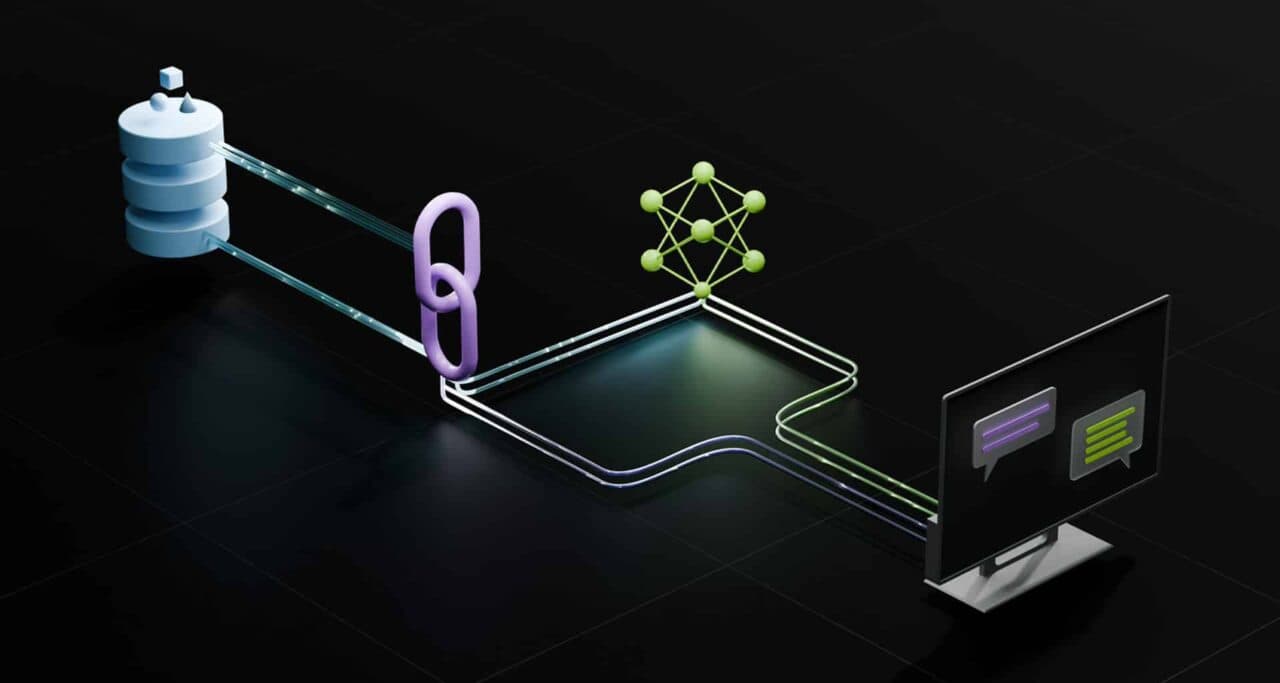
Reference image
The article hero uses the NVIDIA explainer image below so link previews and remote-image handling can be tested during development.
Suggested article structure
This article is intentionally written as a template for future entries:
- Start with a plain-language definition.
- Explain why the topic matters in practice.
- Break down how it works step by step.
- Add one cautionary note or limitation.
- Close with a simple mental model or takeaway.
That pattern fits technical explainers well and works cleanly with the current MDX components.
Component examples used here
This article now includes:
- multiple
MetricGridblocks for summary and evaluation sections - multiple
Calloutblocks for nuance and warnings - a
Stepsblock, a fenced code block, and a markdown table - a
KeyTakeawayssummary block and an explicitFigure
That makes it a practical reference article as well as a content template.