Agent harnesses are becoming one of the most useful ways to think about modern AI systems. As models get better at short tasks, the bottleneck shifts away from one-shot intelligence and toward durability: can the system stay on track across long workflows, tool calls, retries, and verification steps?
That is where the harness comes in. It is the infrastructure around the model that makes long-running agent work reliable enough to use.
Primary role
Govern execution
Core problem
Long-task reliability
Main surface
Tools + lifecycle
Design goal
Durable agents
Why this matters now
For a while, most AI discussion focused on which model was best. That still matters, but it matters less than it used to for practical product work. Once an agent has to plan, call tools, recover from errors, preserve instructions, and keep going for dozens of steps, the quality of the surrounding system becomes visible.
That is the core insight behind Phil Schmid’s article on agent harnesses: static leaderboards can hide the real difference between systems when the actual challenge is whether a model stays coherent after fifty or a hundred actions rather than whether it answers one benchmark prompt slightly better than another.
Insight
Why teams feel the difference in practice
A strong model inside a weak harness often feels inconsistent. A slightly weaker model inside a disciplined harness can feel much more useful because the surrounding system keeps the work legible, bounded, and recoverable.
What an agent harness is
An agent harness is not the model and not the business logic of the final agent. It is the operational layer that wraps the model and gives it a durable environment to work inside.
Typical responsibilities include:
- prompt and instruction presets
- tool execution rules
- planning and re-planning hooks
- context compaction or summarization
- retries, verification, and guardrails
- filesystem, network, or environment access policies
- logging, traces, and trajectory capture
- sub-agent orchestration or task isolation
One useful mental model is:
| Layer | Analogy | Purpose |
|---|---|---|
| Model | CPU | Raw reasoning and token generation |
| Context window | RAM | Limited working memory |
| Harness | Operating system | Context management, tools, policies, lifecycle |
| Agent | Application | Task-specific user-facing behavior |
The analogy is helpful because it stops you from treating the model as the whole system. In practice, the harness determines how the model is booted, what tools it can use, how failures are handled, and how state survives across long tasks.
Harness vs framework vs agent
These terms get mixed together, but they are not interchangeable.
Layer
01Framework
Layer
02Harness
Layer
03Agent
Note
Important distinction
A framework helps you build an agent. A harness helps the agent survive long enough to be dependable.
Why benchmarks are not enough
Modern agent work is often not a single prompt-response exchange. It is a chain of actions:
- understand the task
- decide on a plan
- call tools
- inspect intermediate results
- recover from bad tool output
- verify completion
Traditional benchmarks often under-measure this pattern. They can tell you whether a model is generally capable, but they do not always tell you how that capability degrades over time under real workload pressure.
That is why harnesses matter for evaluation too. A good harness makes it possible to:
- log full trajectories
- compare system behavior across model versions
- capture failure points late in the workflow
- replay difficult tasks
- hill-climb on real user problems instead of vague impressions
01const run = await harness.execute({02 objective: "Refactor the workflow and verify the tests pass",03 tools: ["filesystem", "shell", "search"],04 policy: {05 requireVerification: true,06 retryBudget: 307 }08})09 10if (!run.verified) {11 throw new Error("Agent finished without closing the loop")12}The point of a harness is not only to help the model finish the task. It is also to turn agent behavior into something observable and improvable.
What a good harness usually includes
The exact design changes by product, but strong harnesses tend to share a small set of traits:
| Capability | Why it matters | Failure without it |
|---|---|---|
| Tool policy | Prevents chaotic or unsafe tool use | The agent thrashes, over-calls, or takes risky actions |
| Context control | Keeps the model oriented over time | The agent forgets constraints and drifts |
| Verification hooks | Encourages self-checking before completion | The user becomes the final QA step |
| Trace logging | Makes failures inspectable | You cannot improve what you cannot inspect |
| Modularity | Lets you adapt to new model behavior | The system calcifies around stale assumptions |
The durability problem
The hardest part of long-running agent systems is not usually the first five steps. It is the seventeenth step, or the forty-third, when the system is tired, the context is cluttered, and the initial objective is no longer near the top of working memory.
That is why context engineering and harness design end up so closely linked. If the harness cannot control what the model sees, summarize correctly, isolate subtasks, or re-anchor the objective, the agent starts to drift.
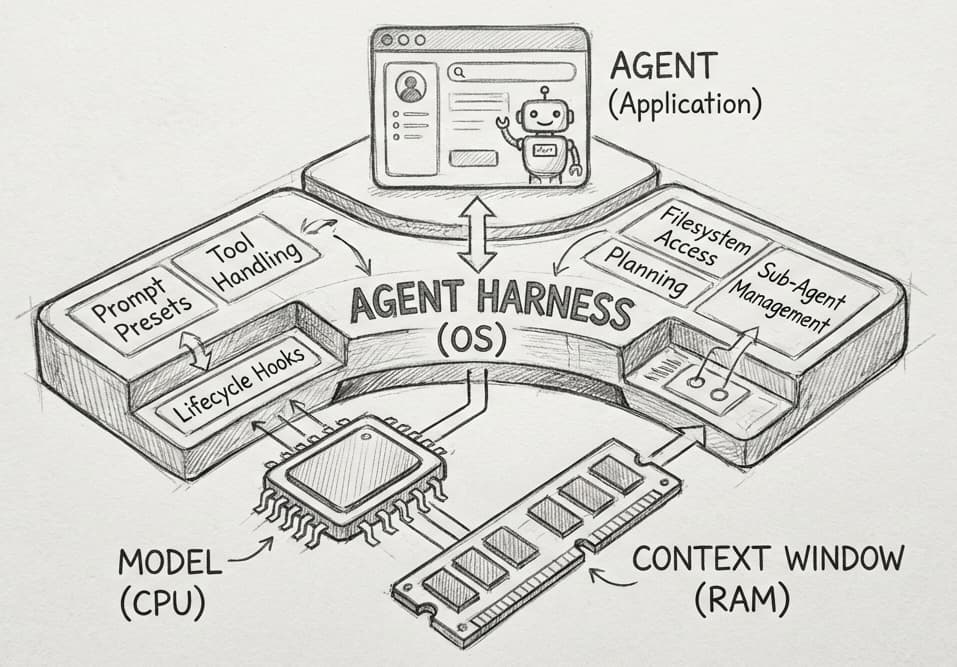
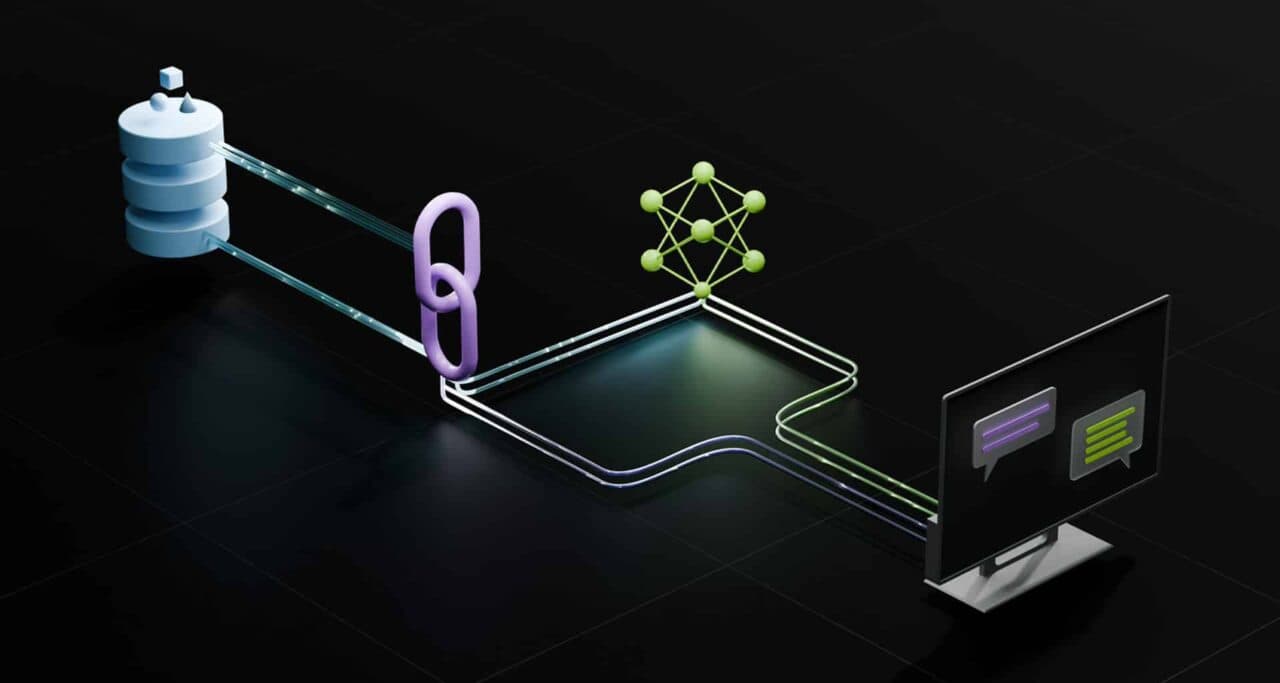
The image above is useful because it highlights the structural point clearly: the harness is the layer that turns raw model capability into a usable system surface.
Design principles worth keeping
One of the strongest ideas in the current agent discussion is that harnesses should be built to change quickly. If you overfit the control flow to one model generation, the next model update can make your elaborate logic obsolete.
Practical design rules:
- keep tools atomic and predictable
- keep execution policies explicit
- prefer simple loops plus verification over clever orchestration
- log enough data to understand where drift begins
- design components so they can be removed as models improve
Warning
Build to delete
The smartest control logic in your harness is often the part most likely to age badly. If a new model can replace a hand-built workaround with a simpler prompt and one verification step, remove the workaround.
Where harnesses create leverage
Harnesses matter most when any of the following are true:
- the task is long-running
- tools have side effects
- the environment is noisy or partially observable
- the user cares about auditability
- the system must improve through real-world feedback
Examples:
- coding agents
- research agents
- workflow automation operators
- support triage systems
- internal copilots with privileged tools
A practical mental model
If you are building agents, the simplest useful reframing is:
Quoted signal
the model is not the product, the harnessed system is
That mindset leads to better engineering decisions. Instead of asking only, “Which model should we use?”, you start asking:
- what should the model see right now?
- what tools should it have?
- how does it recover?
- how does it verify?
- what traces do we keep?
Those are harness questions, and increasingly they are the questions that decide whether an agent feels brittle or dependable.
Further reading
This article takes inspiration from Phil Schmid’s piece:
Related references:
Agent harness takeaways
- An agent harness is the operating layer around the model that manages tools, context, policies, and lifecycle behavior.
- Harness quality becomes more important as workflows become longer, more stateful, and more tool-driven.
- The best harnesses are simple enough to evolve quickly and disciplined enough to capture failures as usable feedback.