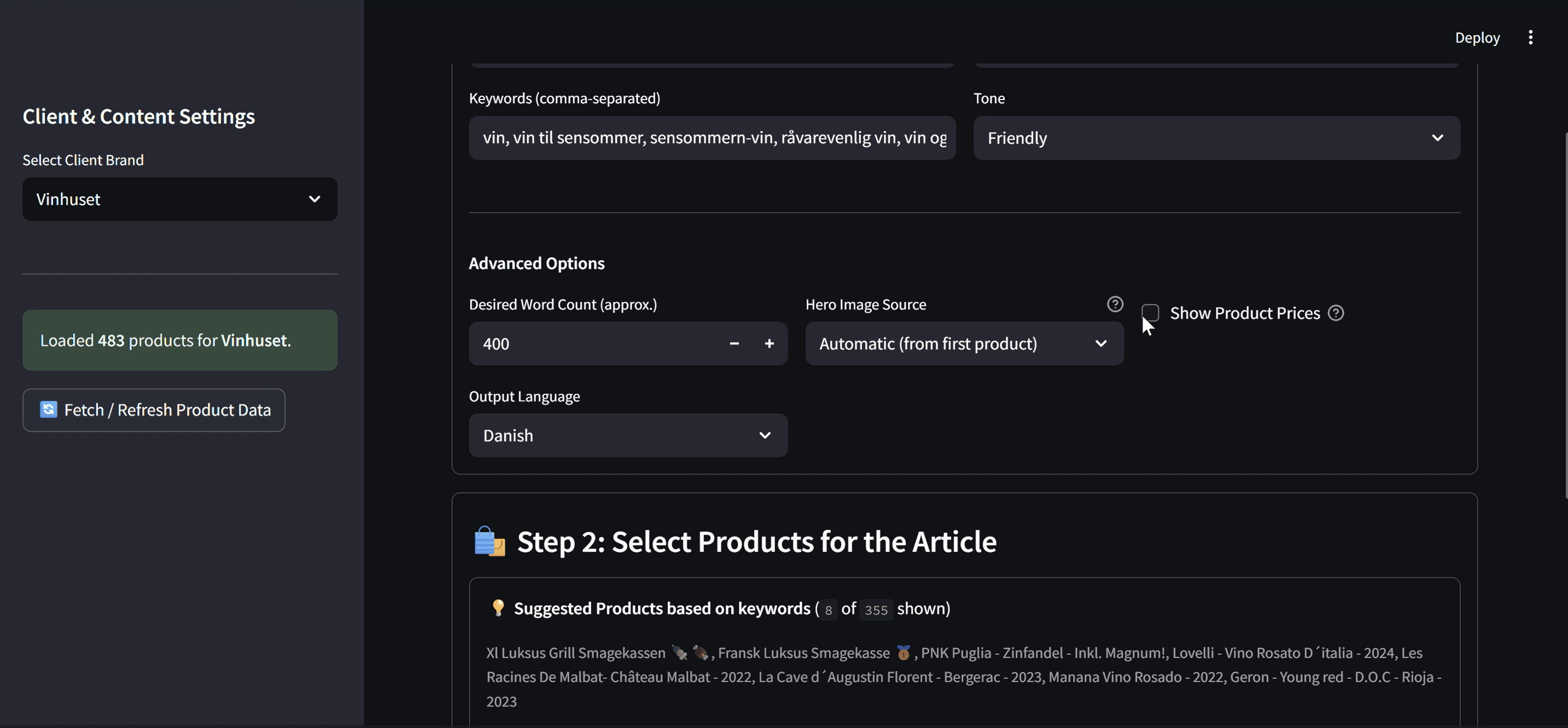
This project was built to remove the manual bottleneck between content planning and a usable Shopify draft. Instead of relying on ad hoc prompting, the system combines brand configuration, catalog data, and structured output rules so content lands in a production-ready format.
Problem
Ecommerce teams often want more organic traffic, but the path from a keyword idea to a reviewed article is slow. Brand voice drifts, product references become inconsistent, and publishing teams waste time reformatting AI output before it can be used.
Solution
I built a Streamlit-based content studio that guides users through brand selection, topic setup, live preview, and Shopify draft upload. The backend pulls product data from Shopify, injects it into a constrained prompt, validates the response with Pydantic schemas, and renders the final article with Jinja2 templates.
Publishing target
Shopify drafts
Theme model
Config-driven
Output shape
Schema-validated JSON
Brand scaling
Template overrides
What made it work
- Brand settings were stored as JSON and deep-merged with defaults so new stores could be added without code branching.
- Product context came from Shopify Storefront data with local caching to keep the writing loop fast.
- The generated output was validated before rendering so templates stayed stable and predictable.
- A test mode made layout iteration possible without burning API tokens.
Note
Missing detail I estimated
The timeline, traffic uplift, and exact number of supported brands were not in the source notes, so the case study focuses on architecture and workflow instead of claimed business results.
Outcome
The result is a repeatable SEO publishing workflow that keeps content quality, formatting, and brand structure under control while reducing the manual lift required to get from idea to publishable draft.